

A lot of people in long-term recovery expect life to feel different after enough time has passed.
Not perfect. Just lighter.
So when you start feeling depressed again, and a drink after work begins creeping back into your routine, it can be confusing. Maybe even unsettling. You worked hard for your recovery. You built a life. Yet something feels off.
At New Heights Recovery Center, we’ve seen this experience more often than people realize. If you’re noticing this pattern, it may be worth exploring whether there’s more happening beneath the surface. Our when mental health and substance use collide services are designed for people facing both emotional struggles and substance use challenges at the same time.
Sometimes It’s Not About the Drink
Many people focus on the drinking because it’s the most visible part of the problem.
The drink happens after work. The drink feels like the decision.
But often, the story starts hours earlier.
Maybe you’ve been feeling emotionally flat for months. Maybe work feels heavier than it used to. Maybe the things that once helped you recharge don’t seem to work anymore.
The alcohol can become less of a cause and more of a response.
Not a healthy response. But a response nonetheless.
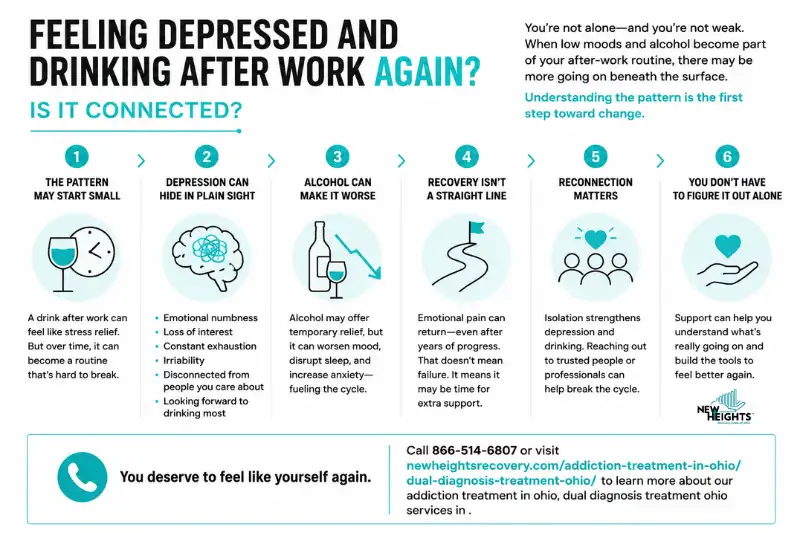
Why Depression Can Hide in Plain Sight
Depression doesn’t always look like staying in bed all day.
For many adults, especially those who’ve been functioning well for years, it looks surprisingly ordinary.
Signs you might be dealing with more than stress:
- Feeling emotionally numb instead of sad
- Losing interest in hobbies or routines you once enjoyed
- Constant exhaustion that rest doesn’t fix
- Irritability that seems out of character
- Looking forward to drinking more than anything else in your evening
- Feeling disconnected from people you care about
One of the hardest parts is that these changes often happen gradually.
Like a room getting darker at sunset, you don’t always notice until it’s already dim.
Why Alcohol Can Make Low Moods Worse
Alcohol often promises relief before it delivers consequences.
At first, it may seem to quiet racing thoughts or soften emotional discomfort. For a few hours, things feel easier.
Then the cycle continues.
Sleep quality declines. Energy drops. Motivation fades. Anxiety often increases. Feelings that were temporarily muted come back stronger the next day.
This is where the depression and alcohol link becomes important. Many people discover that the very thing they’re using to feel better is contributing to the emotional heaviness they’re trying to escape.
That doesn’t mean alcohol caused everything.
It means the relationship between mood and drinking is often more connected than it appears.
Long-Term Recovery Doesn’t Make You Immune to Emotional Pain
One misconception about recovery is that reaching a certain milestone should eliminate struggle.
It doesn’t.
People with years of sobriety still experience grief, burnout, loneliness, disappointment, and depression. Recovery isn’t the absence of emotional pain. It’s having healthier ways to respond to it.
If you’ve been sober before and drinking has returned, it doesn’t erase the progress you made.
It may simply be a signal.
A signal that something needs attention.
A signal that support might be needed again.
Reconnection Often Matters More Than Willpower
Many alumni try to solve this situation privately.
They tell themselves they’ll stop next week.
Or after this project.
Or after things calm down.
The problem is that isolation tends to make both depression and drinking stronger.
Reconnection tends to weaken them.
That might mean talking with trusted friends, returning to support meetings, reconnecting with a therapist, or exploring professional help if emotional symptoms have become difficult to manage.
For some people, structured support becomes the bridge back to stability before things spiral further.
If you’re exploring options, learning about comprehensive care in Addiction or specialized care in Alcohol treatment can help clarify what support is available.
The Question Isn’t Whether You’re Strong Enough
Many people ask themselves:
“Why can’t I just stop this?”
A different question is often more helpful.
“What am I trying to cope with?”
That question shifts the focus from self-criticism to understanding.
If you’ve been feeling depressed, disconnected, and increasingly drawn toward alcohol after work, there may be a reason. And finding that reason is often where real progress begins.
Recovery isn’t about pretending you’re okay.
It’s about paying attention when something inside you is asking for help.
Call 866-514-6807 or visit our dual diagnosis treatment services to learn more about our addiction treatment in ohio, dual diagnosis treatment ohio services in Ohio.