
By day, you answered emails, showed up to meetings, made dinner, laughed at the right moments, and kept the wheels turning.
By night, it got quieter. And harder.
That’s the part most people never saw.
Somewhere between the end of the workday and trying to fall asleep, the pills became less of a reward and more of a ritual. Something to smooth the edges. Something to shut your brain off. Something you promised yourself you’d get under control next week.
If that sounds familiar, you’re not alone. And you’re not “too functional” to need help. Many people who eventually reach out for support through an intensive outpatient program in Ohio spent years convincing themselves they were still managing.
Until the exhaustion started leaking into everything.
Nobody Around You Knew How Bad It Had Gotten
That’s part of what makes high-functioning addiction so isolating.
You don’t look like the version people imagine. You still pay bills. You still answer texts. Maybe you’ve even become the dependable one in your family or workplace.
But internally, life starts shrinking.
You begin calculating how much you can take without anyone noticing. You avoid certain conversations because you’re afraid someone will hear it in your voice. You wake up already negotiating with yourself about whether tonight will be “different.”
And the strangest part? Sometimes success becomes camouflage.
People praise your work ethic while you’re quietly unraveling.
This is often the hidden impact of relapse and ongoing substance use—the struggle remains largely invisible to others while taking a growing emotional toll behind the scenes.
The Evenings Started Feeling Like Survival
For a lot of people, the spiral doesn’t happen at parties or bars. It happens in ordinary moments.
Pulling into the driveway after work.
Sitting in the car for a few extra minutes.
Standing in the kitchen staring at nothing.
The day demanded so much from you that using started to feel less like escape and more like permission to stop performing.
That’s why shame keeps people stuck for so long. They think:
If I were really struggling, wouldn’t my life look worse than this?
Not necessarily.
Sometimes addiction looks like someone who hasn’t fully exhaled in years. That’s also why holding it together feels so hard—because maintaining the appearance that everything is fine can become exhausting in its own right.
You Don’t Have to Lose Everything Before You Take This Seriously
A lot of people wait for a catastrophe that never comes.
No arrest. No dramatic intervention. No public collapse.
Just a slow erosion of peace.
You become emotionally unavailable without meaning to. Your sleep gets worse. Your patience disappears. You stop recognizing yourself in quiet moments.
And eventually, the thing you once used to cope becomes another source of pressure.
That’s often where people begin looking into options like structured evening treatment or multi-day weekly support. Not because their life exploded — but because they’re tired of carrying everything alone.
The same idea applies in recovery: missing meetings doesn’t mean failure. What matters most is recognizing when you need support and being willing to reconnect with it.
For people searching for opioid treatment Columbus Ohio, this middle space matters. The space where you’re still functioning, but you know something isn’t right anymore.
Recovery Isn’t About Becoming a Different Person
This fear keeps a lot of high-functioning people from reaching out.
They think treatment means disappearing from their life completely. Losing their identity. Becoming “that person.”
But many people entering outpatient care are professionals, parents, caregivers, students, business owners — people whose lives continued on paper while they quietly struggled underneath.
The goal isn’t to erase who you are.
It’s to help you stop living every day in emotional survival mode.
A good program doesn’t treat you like a stereotype. It helps you understand what’s actually driving the cycle: exhaustion, emotional avoidance, pressure, trauma, burnout, loneliness, or the constant need to keep performing.
That’s also why many people start exploring broader options for care in Addiction before they ever feel “ready” for major change.
The Hardest Part Is Usually the First Honest Conversation
Not detox.
Not paperwork.
Not even admitting there’s a problem.
It’s saying the truth out loud after months or years of minimizing it.
Something shifts the moment someone finally says:
“I don’t think I can keep doing this.”
And contrary to what fear tells you, that sentence usually doesn’t ruin your life.
For many people, it’s the beginning of getting their life back.
Not perfectly. Not instantly. But honestly.
You’re Allowed to Want More Than Barely Holding On
There’s a specific kind of loneliness that comes from looking okay while feeling awful.
People around you may have no idea how much effort it takes to keep appearing “fine.” That disconnect wears people down over time. Quietly. Gradually.
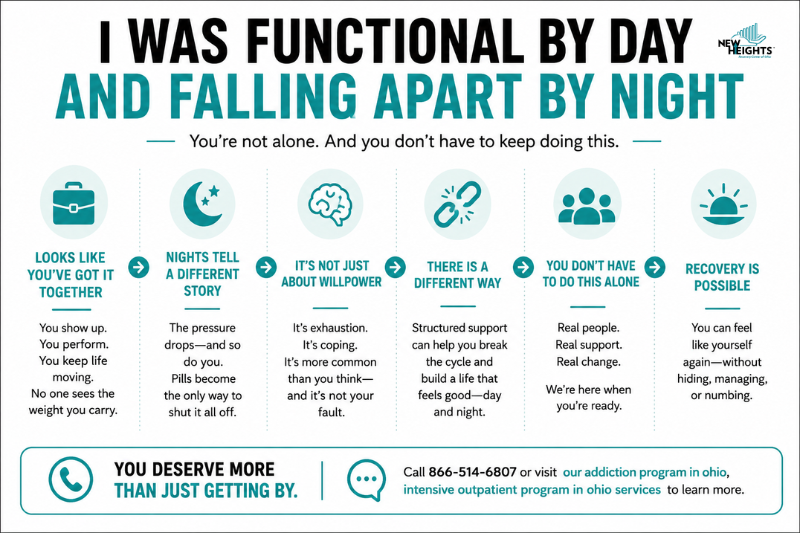
You deserve more than surviving the day and sedating yourself through the night.
You deserve rest that actually feels like rest.
You deserve mornings that don’t start with regret.
And you deserve support before things become catastrophic.
If you’ve been searching for answers, exploring help in Drug recovery options, or wondering whether outpatient support could fit into your life, this may be the moment to stop white-knuckling it alone.
Call 866-514-6807 or visit our addiction program in ohio, intensive outpatient program in ohio services to learn more.