

You’re getting up, going to work, paying your bills. From the outside, nothing looks wrong.
But there’s a quieter question underneath it all: If I drink every night… is that something I should worry about?
If you’ve been wondering that—and maybe avoiding the answer—you’re not alone.
Early on, it doesn’t always look like a problem. It just feels like a routine that slowly gets harder to interrupt.
If you’ve stepped away from support before, or aren’t sure where you stand right now, this might help you find your footing again—including what intensive outpatient program in Ohio care can actually look like when you’re still managing daily life.
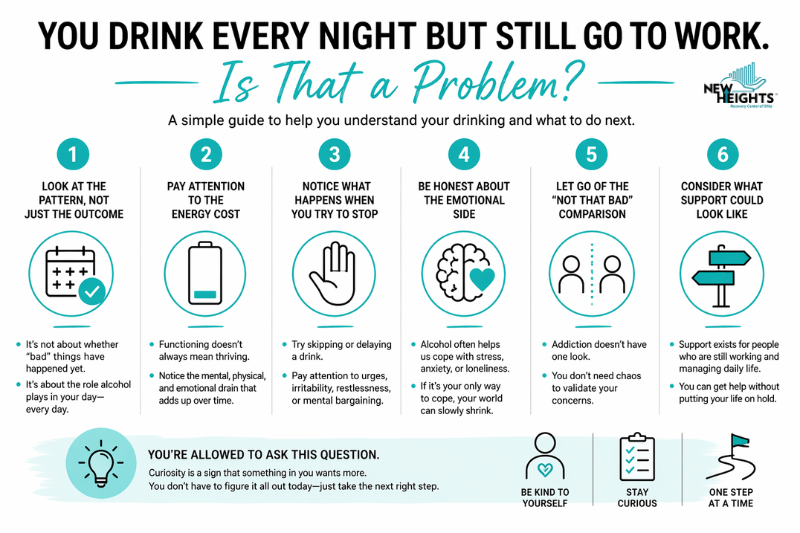
Step 1: Look at the Pattern, Not Just the Outcome
A lot of people measure drinking by consequences.
“I haven’t lost my job.”
“I’m still functioning.”
But the more helpful question is: What role is alcohol playing in your day?
If it’s how you relax, cope, fall asleep, or get through stress—every single night—that pattern matters more than whether anything has “gone wrong” yet.
This is where many people start to recognize the early signs of high functioning alcoholism, even if their life still looks stable.
For families, similar questions often arise when your adult child starts using again, especially when the warning signs are subtle and daily life still appears relatively normal from the outside.
Step 2: Pay Attention to the Energy Cost
Functioning doesn’t always mean thriving.
Some people describe it like carrying an invisible weight:
- Waking up a little more tired than they should
- Needing that drink to feel “normal” again by evening
- Losing interest in things that used to matter
It’s subtle. But it adds up.
A helpful way to check in is to ask:
How much energy is this costing me to maintain?
Step 3: Notice What Happens When You Try to Stop
You don’t have to label anything yet.
Just experiment with awareness.
Try skipping a night—or even delaying your usual drink—and notice what comes up:
- Irritability
- Restlessness
- Strong urges
- Mental bargaining (“I’ll just have one…”)
These moments often tell you more than your daily routine does.
Step 4: Be Honest About the Emotional Side
For many people, drinking every night isn’t about the alcohol itself.
It’s about:
- Turning off anxious thoughts
- Easing loneliness
- Creating a boundary between “work mode” and “real life”
That doesn’t make you weak. It makes you human.
But if alcohol has become your only way to manage those feelings, it can quietly narrow your world.
Step 5: Let Go of the “Not That Bad” Comparison
A lot of people stay stuck here.
“At least I’m not like… them.”
But addiction doesn’t have one look. It doesn’t require chaos to be real.
If something feels off, that’s enough reason to take it seriously.
You don’t have to wait for things to fall apart to make a change.
Step 6: Consider What Support Could Look Like (Without Blowing Up Your Life)
One of the biggest fears is this:
If I admit this is a problem, everything has to change.
That’s not always true.
There are options designed for people who are still working, still showing up, still trying to hold things together—like flexible, multi-day weekly care that fits around your schedule.
If you’ve stepped away from help before, or ghosted a program, that doesn’t disqualify you. It just means you’re human.
Stories about coming back to treatment after setbacks remind us that recovery isn’t defined by perfection—it’s defined by the willingness to keep moving forward.
And you’re still allowed to come back.
You can also explore different forms of support in Alcohol if that feels like a more comfortable first step.
You’re Allowed to Ask This Question
The fact that you’re even asking “Is this okay?” matters.
It means something in you is paying attention.
You don’t have to decide everything today.
You don’t have to label yourself.
But you don’t have to ignore it either.
There’s a middle ground where you can get curious, get honest, and get support—without judgment.
Sometimes that process begins with rethinking what holding it together means, and recognizing that asking for help can be a sign of self-awareness rather than weakness.
If any part of this felt familiar, you’re not alone—and you’re not too far gone or “not bad enough.”
Call 866-514-6807 or visit our addiction program in ohio, intensive outpatient program in ohio to learn more about our addiction program in ohio, intensive outpatient program in ohio services in Columbus, Ohio.