
You’ve already been through so much. Maybe you thought things were stabilizing… and now you’re here again, trying to figure out what your child actually needs this time.
It’s not that you didn’t do enough. It’s that recovery isn’t always linear—and sometimes the level of support needs to change.
Early on, it can be hard to know what kind of help fits where. If you’ve come across options like structured daytime care or multi-day weekly treatment, you’re not alone in feeling unsure. This is where understanding the difference can bring a little clarity—and maybe even some relief.
If you’re trying to make sense of options, this guide can help you navigate what those levels of care actually mean, and how to choose what fits your child right now. You can also explore a deeper breakdown of structured options through this partial hospitalization program in Ohio.
Why “More Support” Doesn’t Mean Something Went Wrong
Many parents quietly carry this thought: If we need a higher level of care, does that mean we failed?
It doesn’t.
Addiction isn’t a single event—it’s something that shifts over time. What worked a few months ago may not be enough today. That’s not failure. That’s information.
Think of it like adjusting treatment for a physical illness. You wouldn’t question increasing care if symptoms worsened. This is no different.
What Structured Daytime Care Actually Looks Like
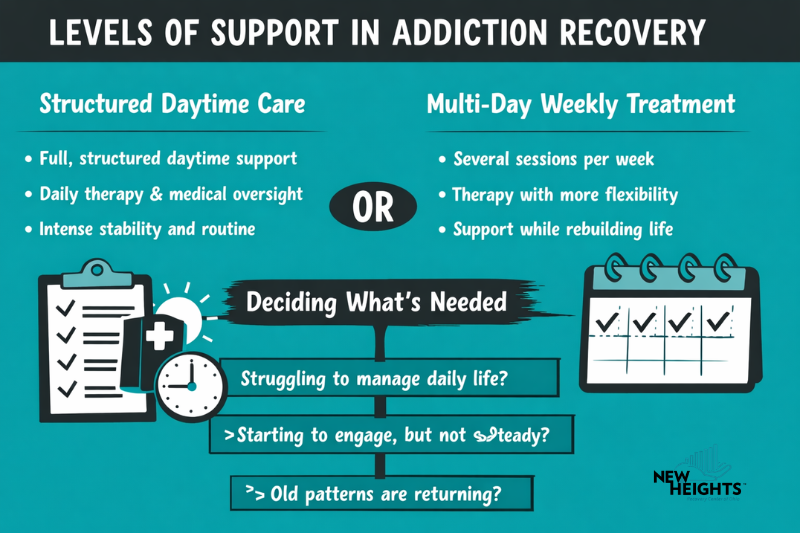
Some programs offer full, structured days of support without requiring your child to live onsite.
This level is often helpful when:
- There’s been a recent return to use
- Mental health symptoms are more intense
- Your child needs daily accountability and stability
It typically includes therapy, medical oversight, and consistent daily routines.
For many families, this becomes a kind of “reset space”—a place where things can stabilize again without fully stepping away from life.
Where Multi-Day Weekly Treatment Fits In
Other programs meet several days a week, but for shorter periods of time.
This level can work well when:
- Your child has some stability but still needs support
- They’re transitioning out of a higher level of care
- They’re rebuilding routines like school or work
It offers structure, but with more independence.
Sometimes parents worry this isn’t “enough.” But in the right moment, it can be exactly what helps someone start taking ownership again.
How to Tell Which Direction Might Be Right
There’s no perfect formula—but there are signals.
You might notice:
- Your child is struggling to get through full days without support
- Emotional swings feel sharper or more unpredictable
- Old patterns are returning quickly
- You feel like you’re constantly trying to hold things together at home
Or, on the other side:
- They’re engaging, but still need guidance
- They’re open to help, just not ready for full-day structure
- They’re trying—but not quite steady yet
This is often where families start comparing options like PHP vs IOP, trying to figure out what actually fits.
The truth is, the “right” level is the one that meets your child where they are—not where you wish they were.
You Don’t Have to Solve This Alone
One of the hardest parts of being a parent in this position is feeling like every decision rests on you.
It doesn’t have to.
A good treatment team helps assess what’s happening right now—not based on fear, but on real patterns, behaviors, and needs.
If your child is struggling with substances, there are options for treatment in Addiction that meet different levels of care without forcing a one-size-fits-all approach.
You’re allowed to ask questions. You’re allowed to not have the answer yet.
It’s Okay That This Feels Hard
There’s a quiet kind of grief in watching your child struggle again. It doesn’t always have words.
But needing to adjust the plan doesn’t mean you’re starting over.
It means you’re still showing up.
And that matters more than you probably realize. For many families, understanding what to expect during the first week in partial hospitalization can make the transition into a higher level of care feel less overwhelming.
Taking the Next Step, Gently
If you’re trying to decide what kind of support makes sense right now, you don’t have to figure it out in isolation.
Call 866-514-6807 or visit our addiction program in ohio, partial hospitalization program in ohio to learn more about our services in Columbus, Ohio.
There’s a path forward from here. Even if it feels uncertain today.