

You made it to work again today.
Your bills are paid. Your responsibilities are mostly handled. From the outside, nothing looks especially wrong.
But maybe you’re reading this because something feels off. Maybe there are nights you can’t fully remember. Maybe the anxiety the next morning feels worse than the hangover. Maybe you’ve started wondering how long you can keep this up.
At New Heights Recovery Center, we talk to many people who are still functioning in their daily lives while privately questioning their relationship with alcohol. If that’s where you are right now, exploring care in Alcohol doesn’t mean you’ve failed. It means you’re paying attention.
Success on the Outside Doesn’t Tell the Whole Story
One of the biggest myths about alcohol problems is that everything has to fall apart before help is needed.
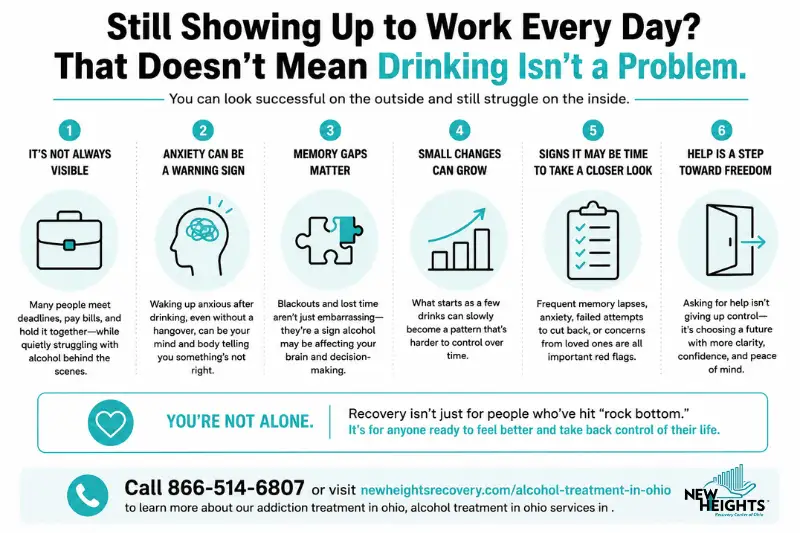
Many people continue to excel at work while struggling with alcohol behind the scenes. They meet deadlines, attend meetings, and show up for family obligations. The problem isn’t always visible.
What often goes unnoticed is the amount of energy it takes to maintain that appearance.
You may spend your mornings fighting anxiety. You may replay conversations from the night before, trying to remember exactly what happened. You may promise yourself you’ll drink less tonight, only to find yourself repeating the same pattern.
Being functional doesn’t always mean being okay.
The Anxiety After Drinking Can Be a Message
Many people search online because they’re experiencing something specific:
They drank heavily, don’t feel particularly hungover, but wake up with intense anxiety and gaps in their memory.
That experience can be frightening.
Alcohol affects areas of the brain responsible for memory formation and emotional regulation. Even if you appear coherent during the night, your brain may not be storing memories properly.
This is why some people begin researching alcohol blackout symptoms after realizing they can’t recall parts of an evening despite appearing relatively normal at the time.
The next-day anxiety often adds another layer of distress. You may find yourself wondering:
- Did I say something embarrassing?
- Did I drive?
- Did I text someone?
- What don’t I remember?
Those questions can linger long after the physical effects of drinking fade.
Small Changes Can Become Bigger Problems
Alcohol-related problems rarely appear overnight.
They’re often gradual.
A drink after work becomes several. Weekend drinking expands into weekdays. Memory lapses become more frequent. The anxiety gets harder to ignore.
Think of it like driving with the check engine light on. The car may keep running for quite a while, but the warning light exists for a reason.
The same can be true with drinking.
The earlier you pay attention to concerns, the more options you typically have available.
Signs It May Be Time to Take a Closer Look
You don’t need a dramatic rock-bottom moment to evaluate your drinking.
Signs You Might Be Experiencing More Than Occasional Overdrinking
- You frequently can’t remember parts of a night out.
- You feel anxious or panicked after drinking.
- You spend time trying to reconstruct events from the previous evening.
- Loved ones have expressed concern about your drinking.
- You’ve tried to cut back but struggle to follow through.
- Drinking feels less enjoyable and more necessary.
- You’re worried enough to be searching for answers.
Sometimes the concern itself is worth listening to.
People rarely spend time researching alcohol-related memory loss because everything feels completely under control.
Asking for Help Isn’t Giving Up Control
One fear we hear often is that treatment means losing freedom.
In reality, many people enter treatment because they want more control over their lives, not less.
The goal isn’t punishment.
The goal is helping you understand what’s happening and giving you tools to move forward.
For some people, that starts with a conversation. For others, it begins by learning more about available help in Addiction.
You don’t have to decide your entire future today.
You only need to decide whether your concerns deserve attention.
The Future Doesn’t Have to Look Like the Present
If you’re showing up to work every day while privately worrying about your drinking, you’re not alone.
Many people wait because they believe things aren’t “bad enough” yet.
The reality is that recovery isn’t reserved for people whose lives have completely fallen apart. It’s available to people who simply recognize that something isn’t working anymore.
The fact that you’re asking questions may be more important than you realize.
Sometimes the most significant turning points don’t start with a crisis. They start with honesty.
Call 866-514-6807 or visit our care in Alcohol page to learn more about our addiction treatment in ohio, alcohol treatment in ohio services in Ohio.